



Mineral Exploration
They're looking for the 'blackest black' || ES.4 - Dr Geo
29:59

Professor Maarten van Aalst discusses how geopolitical conflicts impact our fight against climate change.
While the world focuses on ongoing geopolitical tensions in the Middle East, Professor Maarten van Aalst poses a pressing question: how do these developments affect our fight against climate change? Is an oil crisis yet another setback — or could it also be an opportunity to make our world more liveable at a faster pace?
Professor Maarten van Aalst is Professor of Climate and Disaster Resilience at the University of Twente and Director‑General of the Royal Netherlands Meteorological Institute (KNMI). In his work, he seeks to apply insights from climate science to make societies more resilient to the extremes of the future.
How does he view the challenges of climate change and the energy transition, against the backdrop of everything else that is currently unfolding in the world?
When we think about climate change, we often picture melting ice caps or devastating storms. Yet according to Maarten van Aalst, the greatest risks are often cumulative. A war in the Middle East, as well as the war in Ukraine, may seem to some people to be entirely separate from climate change, but both directly affect our risk landscape.
These wars, for example, drive up the prices of fossil fuels and fertilisers. This happens at a time when agriculture is already under pressure from changing weather conditions.
“As a society, we are being hit twice over,” Van Aalst explains. In his view, it is a false dichotomy to claim that we currently have ‘no time’ for climate action because other crises demand attention. The consequences, after all, are inextricably linked.
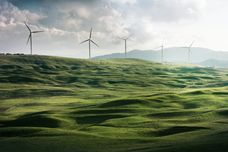
One striking concept in the most recent KNMI report on extreme weather is the Dunkelflaute. Whereas KNMI warnings often focus on spectacular events such as heavy rainfall or severe storms, this phenomenon is remarkably ‘boring’. It refers to a period of cold, windless and overcast winter weather. During such periods, solar panels generate very little electricity and wind turbines stand still, while demand for heating peaks.
If this occurs simultaneously across a large part of Europe, it poses a serious challenge for energy supply.
“This risk partly arises from the way we are trying to tackle climate change,” Van Aalst explains.
The transition to green energy therefore requires additional solutions, such as improved battery storage or power connections to countries with hydropower, like Norway. It also requires insight into when periods of Dunkelflaute are likely to occur.
The solution does not lie in technology alone. Of course, it helps if we build wind turbines that can operate at lower wind speeds, but reducing energy demand may be at least as important. This inevitably involves behavioural change—sometimes in the short term, but ideally through structural reductions in energy use.
In some cases, the solutions are surprisingly simple: working from home an extra day to reduce fossil fuel consumption, or banning outdoor patio heaters, as France has done.
Rather than offering further fuel duty cuts at the petrol pump in response to the war in Iran, the same funds could be invested in lasting solutions—such as income support in the form of heat pumps, or greater investment in electric vehicles.
Despite the complexity of these risks, Van Aalst’s message is ultimately an optimistic one.
He points to Paris as an inspiring example. There, the mayor has translated the Paris Agreement quite literally to the street level, with more greenery, more cycle lanes, and the concept of the 15‑minute city. This means that all everyday amenities—work, schools, shops—are accessible within a fifteen‑minute walk or cycle.
“Paris has genuinely become a more beautiful, more pleasant city. More liveable,” says Van Aalst.
It demonstrates that climate policy is not merely about ‘being allowed less’, but about creating an environment that is simply more enjoyable to live in. “The science developed at the University of Twente helps us to make these transitions not only technically feasible, but also socially just.”
This story has been republished with permission from UT Stories. View the original article here.
Login and start learning!