







Natural Resources Management
Can you tell a plant is thirsty before it wilts?
6 min
In this story, we highlight a PhD candidate's research that used a range of sensors to detect thirstiness in plants.
At the University of Twente, a greenhouse full of tomato plants became the testing ground for that question. The answer involves a thermal camera, invisible light and a very hot July.
Plants sweat, in a way. Their leaves are covered in tiny pores called stomata, which release water vapour that cools the leaf as it evaporates. When the soil dries out, the plant closes those pores to hold on to the water it has left.
That emergency measure has a price. With its pores shut, the leaf loses its cooling and takes in less carbon dioxide for photosynthesis. The plant warms up and processes slow down, well before a single leaf hangs limp.
Joman Alshnaikat, a PhD candidate at the Faculty of ITC, studies how to spot that hidden stage. For her doctoral research, she grew 250 tomato plants in the greenhouse at UT FieldLab, the campus test site where research, education and innovation meet.
Around and above the plants, she set up instruments that each observe the plants in a different way. A thermal camera shows temperature differences between plants, so a warmer, thirstier leaf stands out. Hyperspectral sensors measure how leaves reflect light, split into hundreds of narrow colour bands, including many the human eye can't see. A portable photosynthesis system called the LI-COR LI-6800 clips onto a single leaf and measures photosynthetic activity.
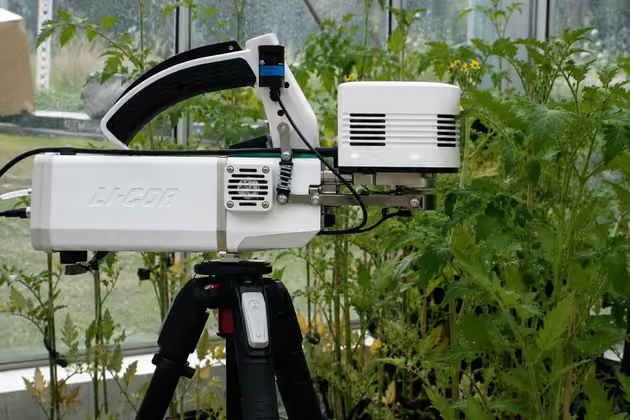
LI-6800F Portable Photosynthesis System (LI-COR Biosciences GmbH, Germany)
Some sensors looked at individual leaves, while others looked down on whole plants from above. "The greenhouse enabled us to connect detailed measurements from individual leaves with measurements of the entire plant canopy," Joman says. "This is important when developing methods that could later be applied using field sensors, drones or satellite observations."
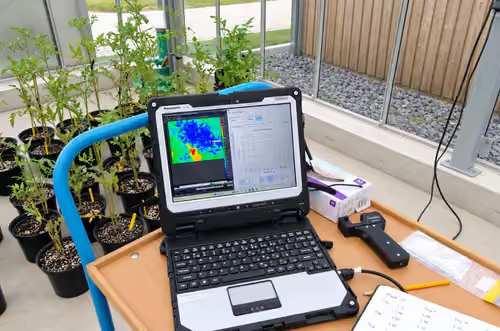
Thermal and spectral measurements were used to monitor differences in plant temperature and light reflectance
A field is realistic but messy. Rain, soil and weather differ from one plant to the next, which makes it hard to know what caused which impact.
In the greenhouse, Joman grew every plant in the same growing medium, with irrigation water of known quality and fertiliser matched to each growth stage.
The weather still had its say. The experiment ran during the July heatwave that hit much of Europe, and on sunny days the greenhouse got 5 to 10°C warmer than outside, peaking at around 45°C. Misting and shading systems, installed beforehand, kept conditions manageable.
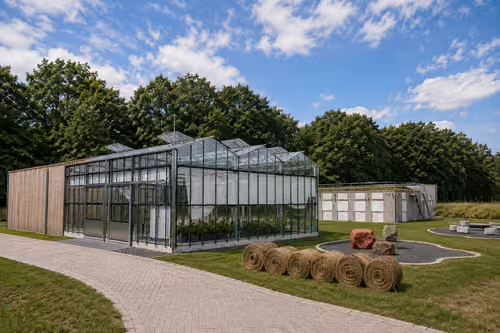
The greenhouse at the University of Twente FieldLab
That heat is also why the choice of tomato mattered. Varieties bred for greenhouses respond differently to temperature and light than field varieties do. "It is important not to select seeds randomly," Joman says. "Researchers should choose a cultivar developed for greenhouse cultivation and suitable for the season in which the experiment will take place."
The close-up measurements are the reference point. If a certain change in reflected light reliably matches a thirsty leaf up close, a similar signal could one day be picked up from much further away. That is the route from a greenhouse bench to drones above a field, or satellite data covering whole farming regions.
None of it was a one-person job. Her supervisors Florian J. Ellsäßer, Haidi Abdullah and Roshanak Darvishzadeh, along with technical staff and research assistants, helped move instruments from ITC's spectroscopy lab, look after the plants, and take measurements. It was also the first full experiment in the new greenhouse, so routines for heat, space and shared equipment were worked out along the way.
Her advice for whoever comes next is refreshingly down to earth. "My main recommendation to future users is to become familiar with the plant they intend to grow before beginning the experiment," she says. Know how much water it needs, how warm it likes it and how it copes with long Dutch summer days. The tomatoes will tell you the rest.
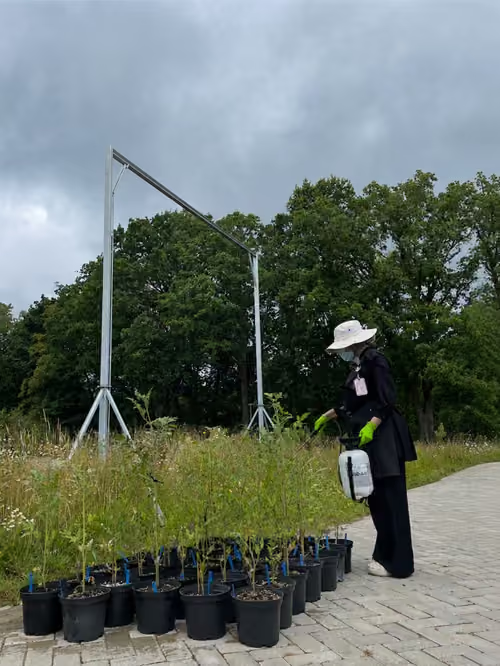
Joman applying one of the experimental treatments to a group of tomato plants during the greenhouse study.
This story has been republished with permission from UT Stories. You can read the original story here on the UT Stories website.
Login and start learning!