



Urban Infrastructure
How Do We Design Cities That Protect Us?
7 min

In this story, design expert Thomas van Rompay explains the challenges of designing cities that are climate-adaptive and promote well-being.
Two crises converge in the urban environment: the climate crisis and the crisis of mental health. Design expert Thomas van Rompay conducts research in the field of planetary health. “I want us to design cities where greenery not only cools the environment, but also calms the mind.”
People struggling with stress, rumination, or depressive symptoms often feel “trapped in their own heads,” Van Rompay explains. Having greenery in one’s surroundings helps to break free from that state: your attention shifts outward, and you feel connected — to others, to nature, to something greater.
At the same time, parks and trees benefit the city itself: they provide shade, cooling, and water buffering. “That dual role is precisely what makes greenery so valuable in urban areas.”
Designing cities that promote mental well-being and are climate-adaptive is a textbook example of a wicked problem.
Why? Because it combines multiple dimensions—from wellbeing and climate to urban planning and social inclusion—without a clear-cut solution. What benefits the climate (more parks) may conflict with housing development.
Moreover, many stakeholders are involved, from residents to policymakers, each with their own priorities.
Add the uncertainty of climate change and shifting social dynamics, and you’re dealing with a challenge without a definitive endpoint: every intervention triggers new effects.
So how do you design green spaces that heal the mind, adapt to climate, and respect diverse interests?
“You’re dealing with policy frameworks, landscape architecture, psychology, urban planning and geography—each with its own timescales and priorities.” According to Van Rompay, this is where the University of Twente excels: high tech with a human touch, especially through collaboration between the faculties of BMS, ITC and ET.
Many solutions begin not with imposing ideas, but with involving people. “If you enter a neighbourhood talking about ‘climate adaptation’ and ‘return on investment models’, people tune out. Talk about heat, street flooding, shade—things people actually feel. And show residents, in concrete terms, what’s possible.”
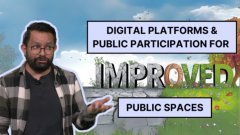
This is where Van Rompay’s second area of expertise comes in: design. He and his team use apps, 360° video, and game engines like Unity to simulate environments.
“We show residents, healthcare professionals and policymakers different scenarios: a park with more or fewer trees, or varying levels of biodiversity. The difference between a dystopia and a utopia becomes instantly clear.”
This approach works well in participatory processes with older adults, but is equally effective in conversations with urban planners.
Simulations also serve as research tools. “They allow us to adjust one environmental feature at a time—something that’s impossible in a real city. This way, we can test what actually works: types of greenery, elevation changes, sightlines, benches, shade.”
In healthcare contexts, he prefers projections or large screens over headsets. “If someone is confined to a hospital bed for a long time, a digital green environment can genuinely help. But you don’t want to isolate patients even further. That’s why I believe more in augmented reality than in VR headsets.”
Many municipalities do have green spaces and trees, but their distribution across districts, neighbourhoods and streets is often uneven. This means that many residents lack sufficient exposure to and access to trees and other greenery.
The 3+30+300 rule (see box below) offers a simple, scientifically grounded guideline for urban greening. It identifies three key elements to ensure access to and benefits from urban forests and green spaces. “It’s useful as a compass, not as a rigid standard,” Van Rompay adds.
“The temptation is to use this as a checklist, but its purpose is to guide and encourage local tailoring.”
Van Rompay also emphasises social justice in this context. “People experiencing homelessness, residents with low incomes or poor housing conditions often face a double burden — greater climate risks and less access to nature.” Don’t label them as ‘vulnerable groups’, he argues, but regard them as co-designers with unique insights. “They know better than anyone what it’s like to live in a city during heatwaves or heavy rainfall. Actively include those perspectives in your design.”
Tools like geodata can help make these disparities visible. “Where are stress or health indicators high? Where is access to parks limited? That’s how you identify urgency and opportunities for impactful interventions.” Pilot projects with colleagues from the ITC Faculty demonstrate how powerful this approach can be, he says.
What makes a landscape truly healing? Van Rompay points to the emotion of awe — the feeling of being small in the presence of something vast, like a mountain range or an endless sea. “People feel connected, and it becomes easier to let go of mental clutter.”
But there’s a paradox: alongside wide-open vistas, we also need refuge — places that feel sheltered and safe. “In interviews with older adults, this combination keeps coming up. A truly restorative space offers both expansive views and a sense of protection.”
How does he experience this himself?
“By consciously leaving the city”, he laughs. “On my racing bike through open landscapes, or on foot in places with wide views. I notice the difference immediately — going from the stifling feeling of the city to open space shifts your attention from inward to outward.”
Through design and technology, he wants to make that experience accessible to those who can’t easily go outside, from hospital patients to older adults with limited mobility.
Planetary health may sound vast and abstract, but Van Rompay’s work starts at the local level: with a small park that buffers water and provides shade; with a projection in a hospital that allows a bedridden patient to feel momentarily outdoors; or with a co-design session where neighbourhood residents create more shade and resting spots in their immediate surroundings.
It’s precisely this connection — addressing climate change while promoting mental well-being — that makes cities and their inhabitants more resilient. The wicked problems won’t disappear overnight, but with psychological insight, thoughtful design and digital imagination, they become more manageable — for everyone.
Want to learn more about how our environments can affect our well-being? Check out this Geoversity story, Exploring Well-being in the Netherlands.
This story has been republished with permission from the UT Stories website.
Login and start learning!