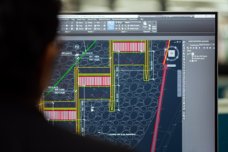



Advanced ENVI for GEOINT is a scenario-based follow-on to ENVI Basics for GEOINT, designed for remote sensing specialists, geospatial engineers, or risk managers wanting to produce advanced products to support various operations. The 10 modules represent scenarios in which students solve complex real-world geospatial problems and generate sophisticated, actionable intelligence products from diverse sensor sources.
Core Components:
- Advanced Spectral Processing and Analysis: Utilizes hyper- and multispectral imagery for feature detection, material identification, and classification.
- LiDAR Point Cloud Processing: Navigating 3D point clouds, measuring distances, and generating elevation raster or vector products.
- 3D Terrain Analysis: Exploit high-resolution, stereographic images to generate raster elevation products and use viewshed tools to determine zones of visibility for field operations.
- Workflow Automation: Utilizing ENVI’s Modeler and IDL for scripting, customizing, and automating repeatable GEOINT tasks.
- ArcGIS Pro Integration: Export ENVI Modeler workflows as ArcGIS Pro toolboxes and synchronize both applications displays for enhanced spatial analysis.
Learning outcomes
After this course, you will be able to:
- Process and analyze LiDAR, optical, and SAR data in ENVI to generate elevation models, vegetation metrics, and activity-based insights.
- Apply supervised, unsupervised, machine learning, and deep learning techniques for land cover classification, material identification, and aircraft detection.
- Perform advanced spectral and change detection analyses, including vegetation indices and target detection.
- Create and automate geospatial workflows using ENVI Modeler, ENVI + IDL, and custom tools to produce repeatable, value-added products.
- Generate 3D products and terrain models from LiDAR and stereo imagery, including point clouds, DSMs, and visibility analyses for route and observer planning.
- Integrate ENVI outputs with ArcGIS Pro to support broader GIS workflows and decision-making environments.
These skills will enable you to move from manual, time-consuming tasks to accelerated, automated workflows, enhancing situational awareness for applications such as threat detection, crisis response, and environmental monitoring.